


New Jersey Climate News
News Aggregation from the NJ Climate Change Resource Center
ENERGY
One size fits all? Testing coating thickness for solar panels
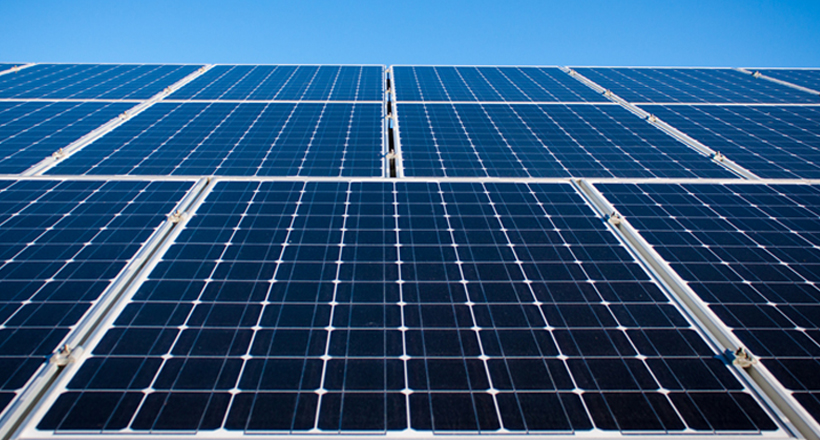
RUTGERS SEBS and NJAES NEWSROOM – As the world races to reduce fossil fuel use and combat climate change, solar energy has become the fastest-growing renewable energy source globally. But not all solar panels are set up the same way. Some are fixed in place, tilted toward the sun. Others track the sun’s movement throughout the day. And a newer type, called vertical bifacial panels, stands upright and captures sunlight from both sides—perfect for farms where crops and solar panels share the same land.
Scientists have long known that adding a special coating to solar panels helps them capture more sunlight by reducing glare and reflection. But would these different panel types need different coatings to work best? Dunbar Birnie, affiliate of the Rutgers Climate and Energy Institute and professor in the Materials Science and Engineering Department at Rutgers University, co-authored a study in the journal Solar Energy that answers this question.
The authors calculated how much sunlight hits each type of panel at different angles throughout a typical year in New Jersey. They found something surprising: despite major differences in how these panels face the sun, they all work best with nearly the same coating thickness—between 160 and 180 nanometers (about 1,000 times thinner than a human hair).
This discovery matters for expanding solar energy. Manufacturers can produce one standard coated glass for all panel types, making production simpler and cheaper. This is especially important for vertical bifacial panels used in agrivoltaics, where farmers grow crops beneath or between solar panels. These dual-use systems help produce clean energy without sacrificing valuable farmland—addressing both climate change and food security.
“Finding that one coating works well for all panel orientations removes a potential barrier to adopting newer solar technologies,” said Birnie. “This could help accelerate the transition to renewable energy by making it easier and more cost-effective to manufacture solar panels for diverse applications, from traditional solar farms to agricultural settings.”
The standardization could reduce manufacturing costs and speed up the deployment of solar energy, helping meet global goals to add 1,000 gigawatts of renewable power annually.
You can read the full study here: https://doi.org/10.1016/j.solener.2025.113870
This article was written with assistance from Artificial Intelligence, was reviewed and edited by Oliver Stringham, and was reviewed by Dunbar P. Birnie III, a co-author on the study.
SUBSCRIBE
Get the latest updates from the NJ Climate Change Resource Center
SHARE THIS PAGE
LATEST HEADLINES

Robert Kopp discusses New Jersey sea level rise on Tidal Flooding Talk
RUTGERS CLIMATE AND ENERGY INSTITUTE

The fight over New Jersey’s tough environmental justice law is now in the courts
EMILIE LOUNSBERRY / INSIDE CLIMATE NEWS

The weather is getting wilder, and some see a dire signal in the data
DAVID GELLES / NEW YORK TIMES

Wind turbines and fish: Can the East Coast have both?
RUTGERS SEBS and NJAES NEWSROOM

Sea levels are already higher than many scientists think, new study shows
SACHI KITAJIMA MULKEY and MIRA ROJANASAKUL / NEW YORK TIMES

Opinion: Trump is attacking climate science. Scientists are fighting back.
ROBERT KOPP / THE NEW REPUBLIC

Will melting glaciers slow climate change? A prevailing theory is on shaky ground
GREG BRUNO / RUTGERS TODAY