ANDREW SMITH / RUTGERS TODAY – Rutgers University researchers will lead several components of a $72.5 million federal initiative to fortify New Jersey’s coast against climate change and extreme weather events.
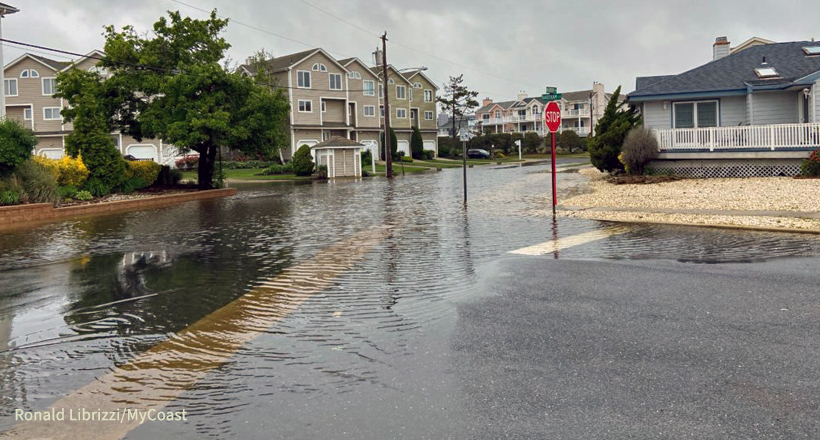
The National Oceanic and Atmospheric Administration awarded the grant to the New Jersey Department of Environmental Protection for the Building a Climate Ready New Jersey program. The five-year initiative seeks to enhance climate resilience across the state’s 16 coastal counties — all with tidal waterways — through projects ranging from flood mitigation to workforce development training and student education.
Rutgers will receive about $16 million of the total grant to lead several program components, according to Lisa Auermuller, administrative director of Rutgers’ Megalopolitan Coastal Transformation Hub.
In addition to building physical resilience, the money will develop the next generation of climate resilience experts by providing hands-on experience for Rutgers graduate and undergraduate students across these projects.
“Rutgers is woven throughout the entire grant, touching all stages of the project,” Auermuller said. “This grant establishes an official pipeline to implement projects that have completed planning and design.”
Christopher Obropta, the extension specialist in water resources with Rutgers Cooperative Extension and a professor with the Department of Environmental Sciences at the Rutgers School of Environmental and Biological Sciences, will lead many of the shovel-ready green infrastructure projects. His team will install these resilience strategies in urban communities to manage stormwater and mitigate flooding.
“Of the $9.5 million that are coming to my group, about $7 million will go to building physical projects designed to manage water, and most of the rest will go to educational programs that train people from those communities to build and maintain such projects,” Obropta said. “Our focus is on Perth Amboy, Newark and Paterson.”
These cities have combined sewer systems where stormwater and sewage flow through the same pipes. These systems often overflow during heavy rainfall, releasing untreated sewage into local waterways and streets.
“Our goal is to implement systems that capture rainwater before it enters the combined system and causes overflows,” Obropta said. “We’re separating these waters, holding and treating the rainwater, then allowing it to percolate slowly into the ground.”
The projects will feature rain gardens built into curb bump-outs and vacant lots, as well as pervious pavement that allows water to seep into underground storage systems.
Rain gardens are green spaces built three to 12 inches below their surroundings to create temporary ponds when storms rage and runoff water fill them. They feature plants that can withstand full submersion for the six to 12 hours it takes the water to seep into the ground.
A 200-square-foot rain garden can manage 30,000 gallons of stormwater per year, Obropta said, so a network of dozens (or hundreds) could greatly reduce flooding throughout entire towns.
Permeable parking lots tend to be larger and manage even more water. However, they cost several times more than regular parking lots and require semiannual maintenance. “It’s definitely an investment,” Obropta said. “But when you consider the potential to prevent costly flooding damage, they can save money overall.”
Obropta emphasized that these solutions will manage stormwater and provide additional benefits such as urban greening, which supports pollinators and reduces heat island effects.
To ensure long-term sustainability and help urban economies, Obropta’s team will partner with Kean University to develop a green infrastructure certification program.
“We’re focused on training local residents to build and maintain these projects,” Obropta said. “This approach keeps the money and expertise within the city, boosting the local economy instead of outsourcing the work.”
Education and outreach form another cornerstone of Rutgers’ involvement in the initiative. Auermuller will help oversee this $3 million chunk of the project, which includes K-12 teacher training and expanding the use of a crowdsourced coastal monitoring app called MyCoast NJ.
“New Jersey leads the nation here,” Auermuller said. “It’s the first state to mandate climate education in school curricula. We’re leveraging this requirement to integrate real-world lessons about local climate impacts and solutions into classrooms across the state.”
Other Rutgers-led projects include:
- Updating a coastal restoration project repository tool, a roughly $1.3 million effort led by Rick Lathrop, director of the Center for Remote Sensing and Spatial Analysis.
- Enhancing the New Jersey Resilience Toolkit for municipal-level planning, a $2 million project headed by Lucas Marxen at the Bloustein School of Planning and Public Policy.
Set to launch Oct. 1, the five-year Building a Climate Ready New Jersey initiative builds upon over a decade of post-Superstorm Sandy resilience work. It aims to create a comprehensive framework for advancing climate adaptation projects from conception to completion.